Thursday, 29 January 2015

Critical Perspectives 11: 4/12/14 - Considering the “Other”, with Alex Franklin
Prep for Semester 2
Content: Assessed Work:
- Blog → Plays the role of a sketchbook (what are you INTERESTED in?)
- Poster → 2pm Feb 9th
- Essay → 26th March
Assessed on these three things en
masse
After Xmas break:
Seminars – program-specific →
uses stuff from the blog
Leading up to poster
No hard-and-fast rules for the
blog – just ongoing engagement
Reference EVERYTHING!!!
(citations)
Have a critical perspectives
folder!
Find a way to manage all this –
don't get hung up on the essay
Better to have too much and edit
it down
The seminars will help you write
it
Use the UWE Harvard reference
system – practice using it on your blog
One set title: “Present a
detailed, critical analysis of a cultural text”
Identify a cultural text
you want to know more about
Find one with a
representation of an idea you want to explore
The “Anaconda” video is a cultural text! Not
just written texts
Critical =/= negative; how and
why things work
Resist the urge to boomerang back
to familiar territory – you're here to learn NEW things
You can mention other texts
(contrast) but don't go into detail
Identify the broader issue
Poster – inherently tied to
your essay
Will be discussed in the seminars
All posters will be exhibited in
February!
Posters in this context are
junior versions of academic presentations
Seminars are at Bower Ashton –
NOT Ashton Court
x1 hour session a week (Thurs.)
except 22nd Jan and 12th Feb
SHOULD be on online timetable
There WILL be prep for seminars –
tasks (see Blackboard)
Seminars make university
university – STEEL YOURSELF; take part
A kind of luxury item – builds
confidence
Office Hours will be posted after
Christmas
Talk to a librarian about
research
Action analysis: Quadruped Locomotion (secondary research)
I decided to focus mainly on dogs for this part of my action analysis, since I've always been interested in the differences between breeds' physiology and temperaments - and now, their movements.
I've found Vines to be an excellent source of animals in motion (the blog Actual Dog Vines is especially helpful), but I've also spotted a few interesting dogs on YouTube. Let's start with this slow-motion advert for root beer:
Look at the way the dog's flabby, loose skin trails behind him as he runs at 0:31! A perfect example of the animation principle known as drag.
I've found Vines to be an excellent source of animals in motion (the blog Actual Dog Vines is especially helpful), but I've also spotted a few interesting dogs on YouTube. Let's start with this slow-motion advert for root beer:
Action analysis: Inorganic Things
Let's kick off this blog's action analysis (the study of How Things Move) section with a bit of fun courtesy of the blog capnskull:

"the drum is filled with hot steam and then sprayed with cold water. the pressure on the outside of the drum is far more than inside. the pressures try to maintain and find balance taking the drum as a casualty."
I really love the suddenness with which the drum "recoils" - it's as if it's alive and reacting slightly belatedly to the water, or as if the drum were an animated character and the animators were chemistry and physics themselves. I'll have to refer back to this drum next time I animate a character reacting suddenly to something.
I didn't have time to research this area in great detail, but I found two artificial lifeforms designed to simulate the movements of living things, and the accuracy (or lacktherof) of that simulation is fascinating. First is this robot, Spot, made by Boston Dynamics - you can see how it got its name, as it simulates a dog's walk fairly accurately. The part I find most interesting is the way it stumbles in response to being kicked at the 0:28 mark of the video - it briefly struggles to regain its footing in much the same way a real quadruped would.
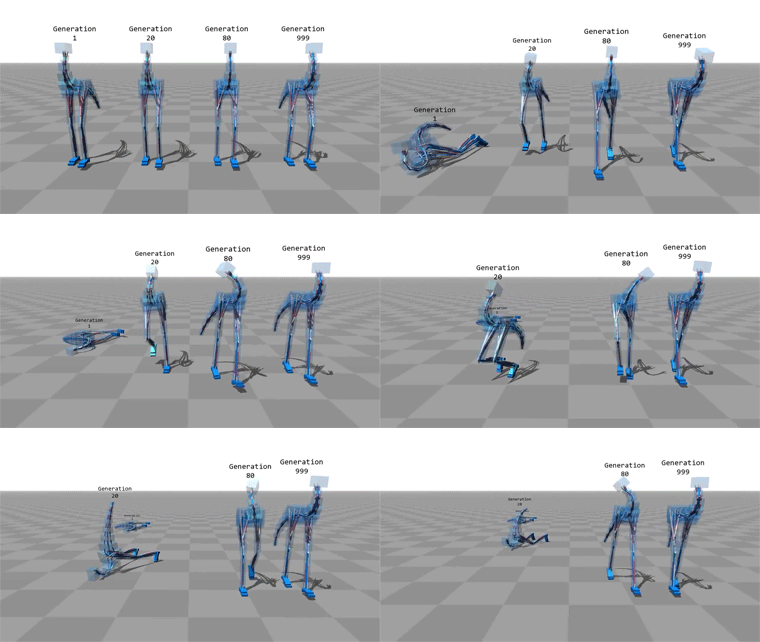
While this isn't quadruped locomotion, it's too fascinating not to at least mention. These are computer programs that taught themselves how to walk - I found this GIF on Imgur and while I looked for more information about the project, unfortunately all I could find out was that Steve Grand, creator of the video game Creatures, is attached to it.
Even so, the learning curve these programs went through is evident in the GIF: Generation 1 obviously only manages half a step; Generation 20 masters taking a few steps but fails to keep its balance for very long; Generation 80 solves that problem by swinging its neck and tail to generate equilibrium; Generation 999 manages to walk without that exaggerated swing.
Generation 80 definitely has the most characterful walk. I feel an incredible urge to animate my character Ikki (see here) walking using it as reference.
Subscribe to:
Posts (Atom)