Here are two animation exercises I did as part of the action analysis project: a stop-motion pull and a CG push.
My first attempt at a pull:
My second, and so far last, attempt at a pull:
My first and only attempt at a push:
Lip sync in Flash:
There's a slight syncing issue at the end of this one due to having to piece the video together when Flash wouldn't export it properly, but it does play properly in Flash, I promise - I'll see if I can export a proper version even if it's too late to get that assessed.
Because I'm so fascinated by dogs as it is, I mostly focused on them for this research assignment - in fact, I ended up drawing so much of them that I have to separate other quadrupeds into their own post!
I visited Noah's Ark Zoo Farm and was very impressed with the variety of species - and therefore, the variety of movements - they had on display. I got some excellent research out of the trip; my only regret was that my phone battery ran out before I could film every single animal!
As soon as I got this action analysis assignment, I rushed to contact anyone I knew who had a dog and asked if I could come over to do some studies during the Easter break. While I waited for said break, I studied dogs from a bit more of a distance in two locations: Queen Square near the centre of Bristol, and Ashton Court Estate. I got some good sketches from both, but I couldn't really get close to the dogs without things getting a bit awkward for me and their owners.
I managed to "borrow" three dogs for closer analysis: Merlin, a 15-year-old Lurcher, Duffy, a 4-year-old Bulldog, and Rudy, a 4-year-old Egyptian Street Dog (like a smaller, lankier German Shepard). I was lucky to get a good variety of ages and breeds, as I feel those two factors affect a dog's movement the most.
After I got the assignment to study flight, I sought out videos of birds, and got very lucky when I discovered this clip from the Natural World documentary "Super Powered Owls":
Scientists set up an experiment designed to examine how an owl achieves silent flight - the perfect thing for an animator to study. I dove straight into the full documentary on BBC iPlayer and did as many sketches of owls (and a few other bird species) as I could. Click Read More to see these sketches (with a few dog and otter studies mixed in).
When I got the assignment of analysing flight dynamics, I realised how lucky I was to live close to Bristol's habourside: it's full of seagulls, pigeons and crows, presenting the opportunity to not only study flight from life, but to compare different species' flight patterns. Doing so was a very interesting insight into how different, yet similar, bird species can be, even within the same geographic location.
I also visited Noah's Ark Zoo Farm and saw their Birds of Prey Display, which was perfect for studying flight: the birds flew right in front of my face, the keepers explained the differences in their flight patterns, and the audience are allowed to stroke Bella the barn owl after the performance. You wouldn't believe how soft a barn owl's feathers actually are (this contributes to their silent flight).
Finally, I went to Slimbridge Wetlands Centre to observe a variety of water fowl. I didn't get as many drawings of them in flight as I would've liked, since they spent most of their time in the water, but I did get some useful videos of swans and ducks flapping their wings - and their otter exhibit came in handy for the quadruped locomotion part of the assignment.
Click Read More to see my observational sketches (with a few dog sketches mixed in) and video recordings.
During my first semester, my tutor Chris Webster said, when setting us an abstract animation exercise, "I don't want no pigs in tutus." Guess what I drew for my character design exercise for the sake of irony!
To make the pigs' movements and stances believable, I studied videos of ballet (of course, the ideal would be drawing them directly from life, but I didn't know of any ballet schools near the centre of Bristol), and particularly larger people doing ballet - as luck would have it, Channel 4's series "Big Ballet" is literally all about that, so I decided to watch it and sketch the most interesting poses and movements as I went.
One of my favourite examples of timing in the dances is at the 18:14 mark - the slight delay of the dancer on the right is just so funny to me, and that comedic timing is something I'd very much like to capture in my animation. As for serious examples, the 30:04 mark is a perfect example of the kind of movement I want to animate: visible weight to the dancer's body, but with a delicacy in the way she carries that weight. I think in my case, it also helps that these aren't professional dancers: my two pigs were a seasoned ballerina and her immature pupil, so it helps to look at all levels of expertise.
In the end, I decided to scrap the "pigs in tutus" idea for another sequence - but I feel my study of dance will still come in handy for my animation practice.
Click "Read More" to see the sketches I did while watching episode 1!
I decided to focus mainly on dogs for this part of my action analysis, since I've always been interested in the differences between breeds' physiology and temperaments - and now, their movements.
I've found Vines to be an excellent source of animals in motion (the blog Actual Dog Vines is especially helpful), but I've also spotted a few interesting dogs on YouTube. Let's start with this slow-motion advert for root beer:
Look at the way the dog's flabby, loose skin trails behind him as he runs at 0:31! A perfect example of the animation principle known as drag.
Let's kick off this blog's action analysis (the study of How Things Move) section with a bit of fun courtesy of the blog capnskull:
"the drum is filled with hot steam and then sprayed with cold water. the pressure on the outside of the drum is far more than inside. the pressures try to maintain and find balance taking the drum as a casualty."
I really love the suddenness with which the drum "recoils" - it's as if it's alive and reacting slightly belatedly to the water, or as if the drum were an animated character and the animators were chemistry and physics themselves. I'll have to refer back to this drum next time I animate a character reacting suddenly to something.
I didn't have time to research this area in great detail, but I found two artificial lifeforms designed to simulate the movements of living things, and the accuracy (or lacktherof) of that simulation is fascinating. First is this robot, Spot, made by Boston Dynamics - you can see how it got its name, as it simulates a dog's walk fairly accurately. The part I find most interesting is the way it stumbles in response to being kicked at the 0:28 mark of the video - it briefly struggles to regain its footing in much the same way a real quadruped would.
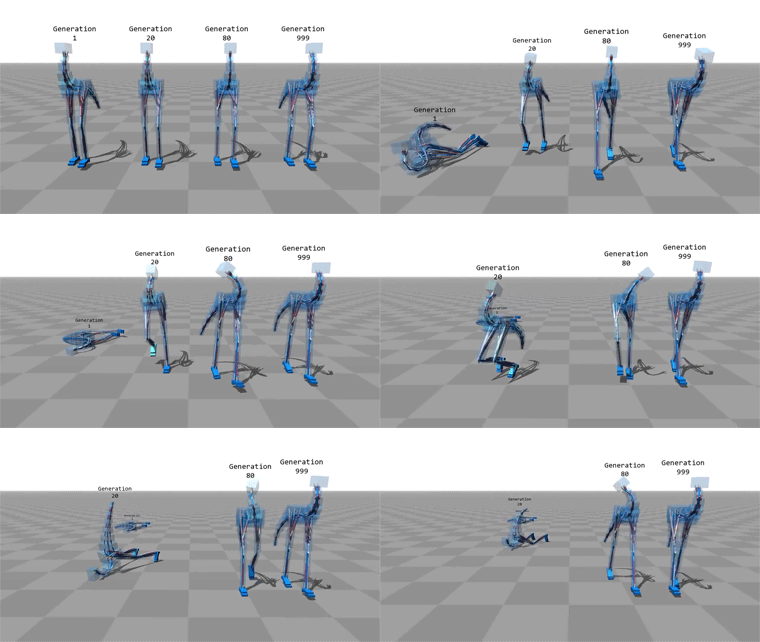
While this isn't quadruped locomotion, it's too fascinating not to at least mention. These are computer programs that taught themselves how to walk - I found this GIF on Imgur and while I looked for more information about the project, unfortunately all I could find out was that Steve Grand, creator of the video game Creatures, is attached to it.
Even so, the learning curve these programs went through is evident in the GIF: Generation 1 obviously only manages half a step; Generation 20 masters taking a few steps but fails to keep its balance for very long; Generation 80 solves that problem by swinging its neck and tail to generate equilibrium; Generation 999 manages to walk without that exaggerated swing.
Generation 80 definitely has the most characterful walk. I feel an incredible urge to animate my character Ikki (see here) walking using it as reference.